Inspection: The Exam You've Been Taking All Along
Stage × AI, issue 33 of ~38. One stage per issue: what the stage really does, where AI helps, where it must not, and one buildable pattern.
Confidence: hypothesis. The failure modes here are drawn from published inspection findings and widely reported industry patterns, not firsthand deployment. The buildable pattern at the end is not: it is an unbuilt design. Argue with it.
What this stage really does
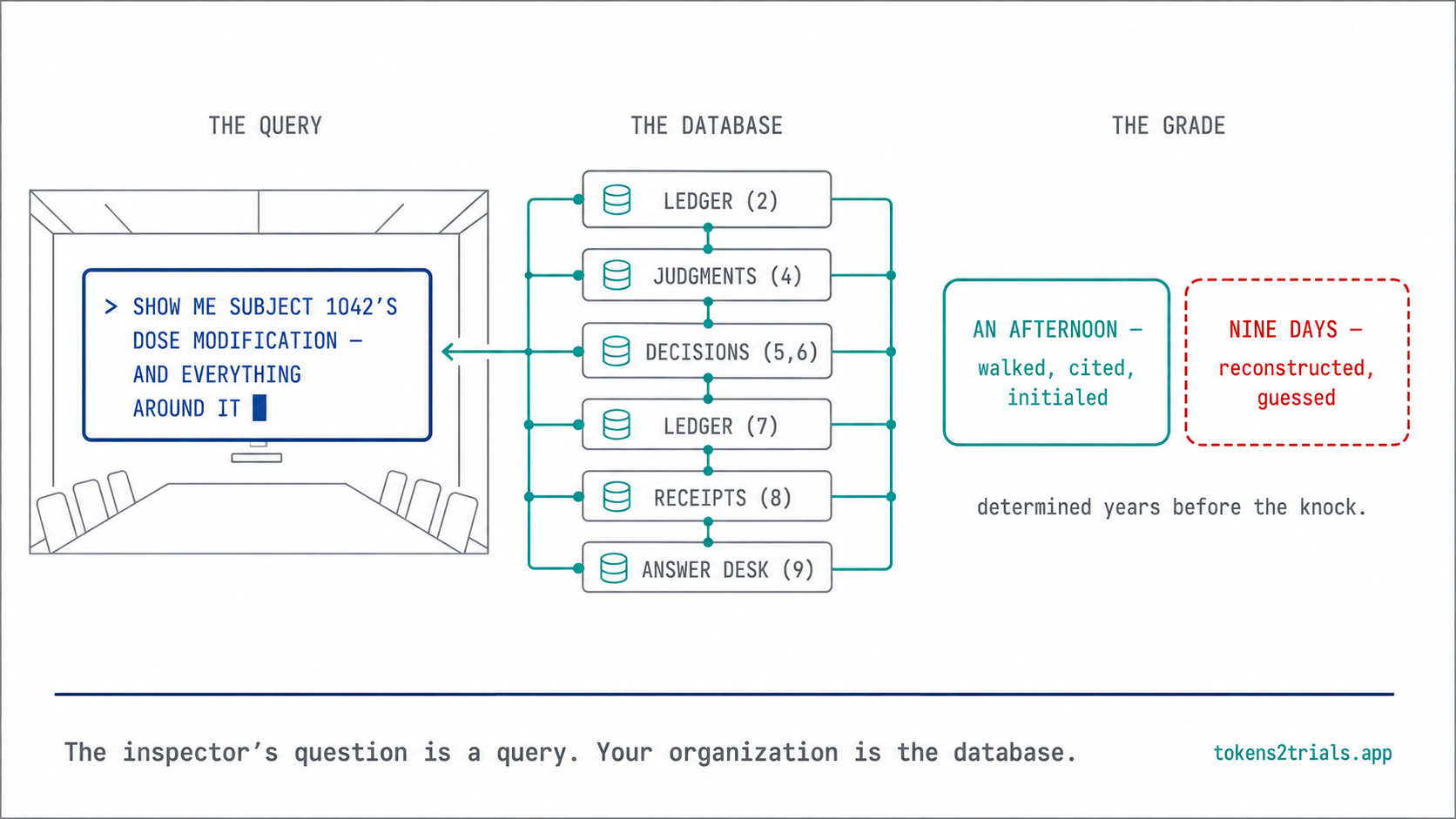
At some point — before approval, on routine schedule, or for cause — a regulator's inspector sits down in a sponsor's, site's, or CRO's conference room and starts asking questions. Show me the delegation log. Show me subject 1042's dose modification and everything around it. Show me how this deviation was found, escalated, and fixed. Walk me through who knew what, when. The stage's machinery: the trial master file that is supposed to contain the trial's whole story, document retrieval under a ticking meeting clock, interviews with the people who did the work, and afterward findings, responses, and corrective actions with commitments attached.
Two properties define the stage. First, an inspection is a retrieval exam. The inspector's question is a query; the organization is the database; the score is precision, latency, and the coherence of what comes back — EMA's own GCP guidance requires sponsors to give inspectors direct access, without undue delay, to authentic source data and a complete TMF. Regulators write their findings accordingly — not “a deviation occurred” but “the sponsor could not demonstrate, could not produce, could not explain.” Inspectors may treat well-documented deviations more favorably than undocumented or chaotic records. What they cite is chaos: the record that cannot be found, the story that changes between interviews, the decision no one can reconstruct. EMA's 2023 GCP inspection findings recorded 720 deficiencies across 67 inspections — and the single largest subcategory in the entire report, ahead of every other cause, was Essential Documents: 74 findings, almost all of them exactly this kind of chaos — missing documents, undefined storage locations, inspection readiness nobody had rehearsed.
Under the Hood · 5
5 capability-angle deep-dives generalizing this essay's pattern for AI and software engineers.
Engineering for the day someone else writes the queries.
Audit readiness is a residue, not a project.
Generative tools with no write path to the record.
Chaos engineering for the document layer.
Demonstrating oversight, not claiming it.