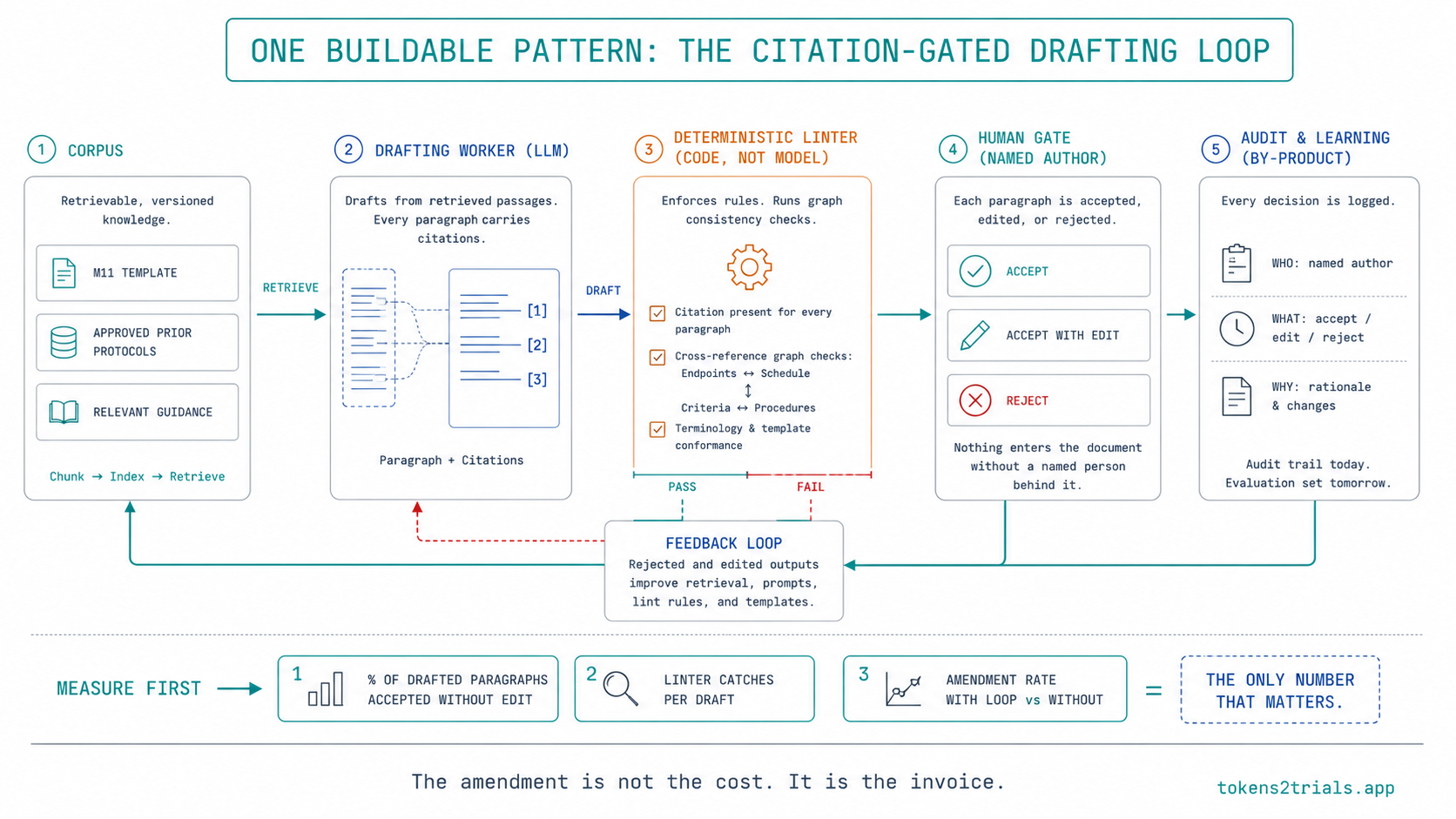
The Citation-Gated Drafting Loop
The system can be wrong, but it can never be unaccountable.
Confidence: hypothesis. The failure modes below are drawn from published industry research on protocol amendments, not firsthand deployment. The pattern is not: I have not shipped it. Argue with it.
Across the industry, teams are running the same movie. An engineer wires an LLM to draft documents, the demo is dazzling, and then someone from quality or compliance asks one question that kills the project:
“Who wrote this sentence?”
Not “is it accurate.” Not “did it hallucinate.” Who owns it. In a regulated industry, a sentence nobody can stand behind is not a productivity gain — it is a liability with formatting. And the standard answers (“the model is very good now”, “a human reviews everything”) do not survive contact with an auditor, because “a human reviewed it” is not the same as “a named human is accountable for it.”
Clinical drug development — one of the most heavily audited document cultures on earth — shows what an unaccountable sentence actually costs. This piece walks through that cost, and then a pattern — the citation-gated drafting loop — that lets an LLM draft inside that culture without breaking it. The pattern generalizes to any domain where documents carry legal or financial weight: SOPs, underwriting policies, safety cases, financial disclosures.
Why one sentence can cost millions
A clinical trial protocol is not a description of a study. It is the study's operating contract. The data-capture system derives its forms from the protocol's visit schedule. Statisticians derive their analysis populations from its endpoints. Safety teams configure adverse-event reporting against it. Half a dozen vendors configure their systems from its specifications. Sites and patients never experience it as a document at all — they experience it as the study's daily operating system.
This pattern is one piece of a longer treatment. The full essay is issue 2 of Stage × AI, a series walking the entire clinical-trial lifecycle stage by stage — what each stage really does, where AI helps, where it must not go, and one buildable pattern per stage:
full essayEvidence in, evidence out. Corrections welcome.