Protocol Design: The Document That Runs the Trial
Stage × AI, issue 2 of ~36. One stage per issue: what the stage really does, where AI helps, where it must not, and one buildable pattern.
Confidence: hypothesis. The failure modes in this essay are drawn from published industry research on protocol amendments, not firsthand deployment. The buildable pattern at the end is not: I have not shipped a protocol-authoring system. Argue with it.
What this stage really does
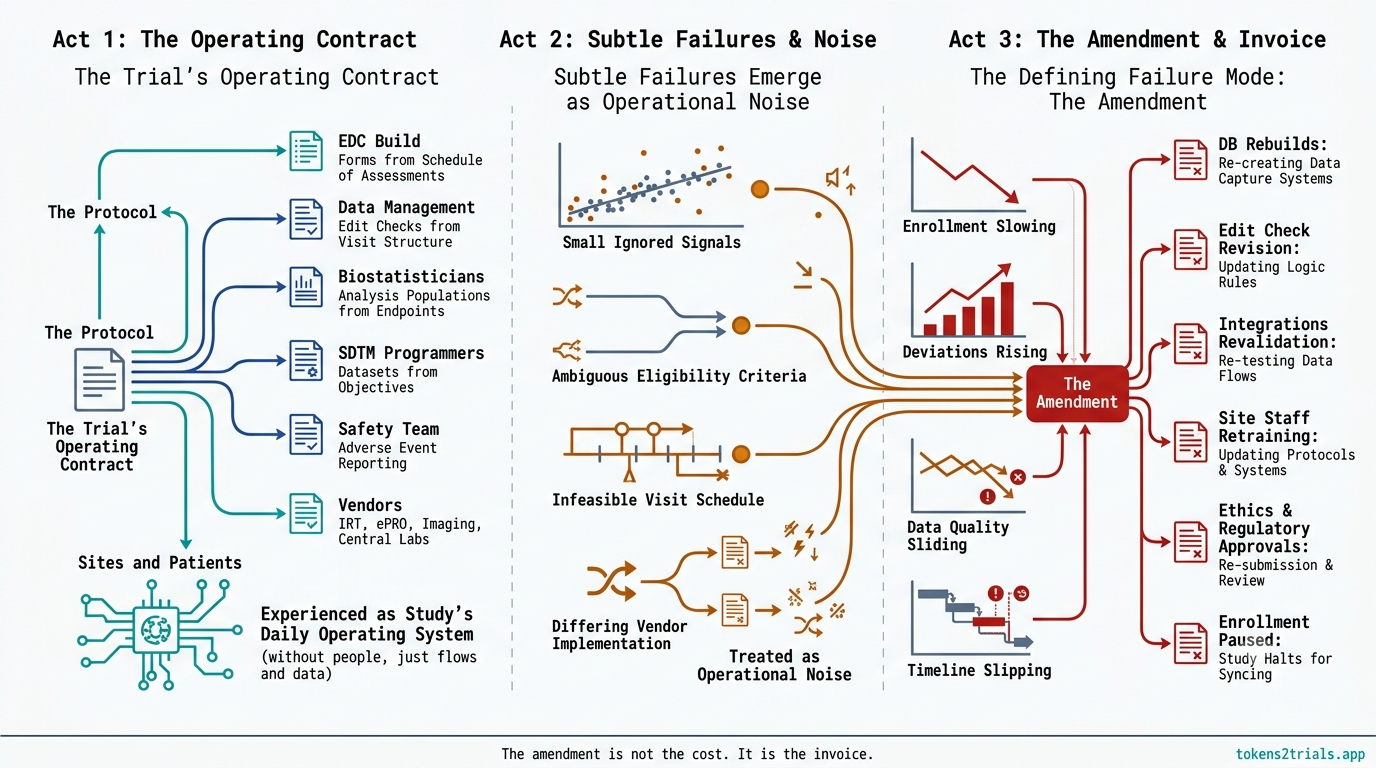
A protocol is not a description of a trial. It is the trial's operating contract — the single source from which every downstream capability is designed, configured, validated, and executed. The EDC build derives its forms from the schedule of assessments. Data managers define edit checks from its visit structure. Biostatisticians derive analysis populations from its endpoints; SDTM programmers map datasets from its objectives. Safety teams configure adverse event reporting against it. Vendors configure IRT, ePRO, imaging, and central labs from its specifications. Sites and patients never experience the protocol as a document at all — they experience it as the study's daily operating system.