Designing the "No"
Boundaries drawn on consequence, not on capability.
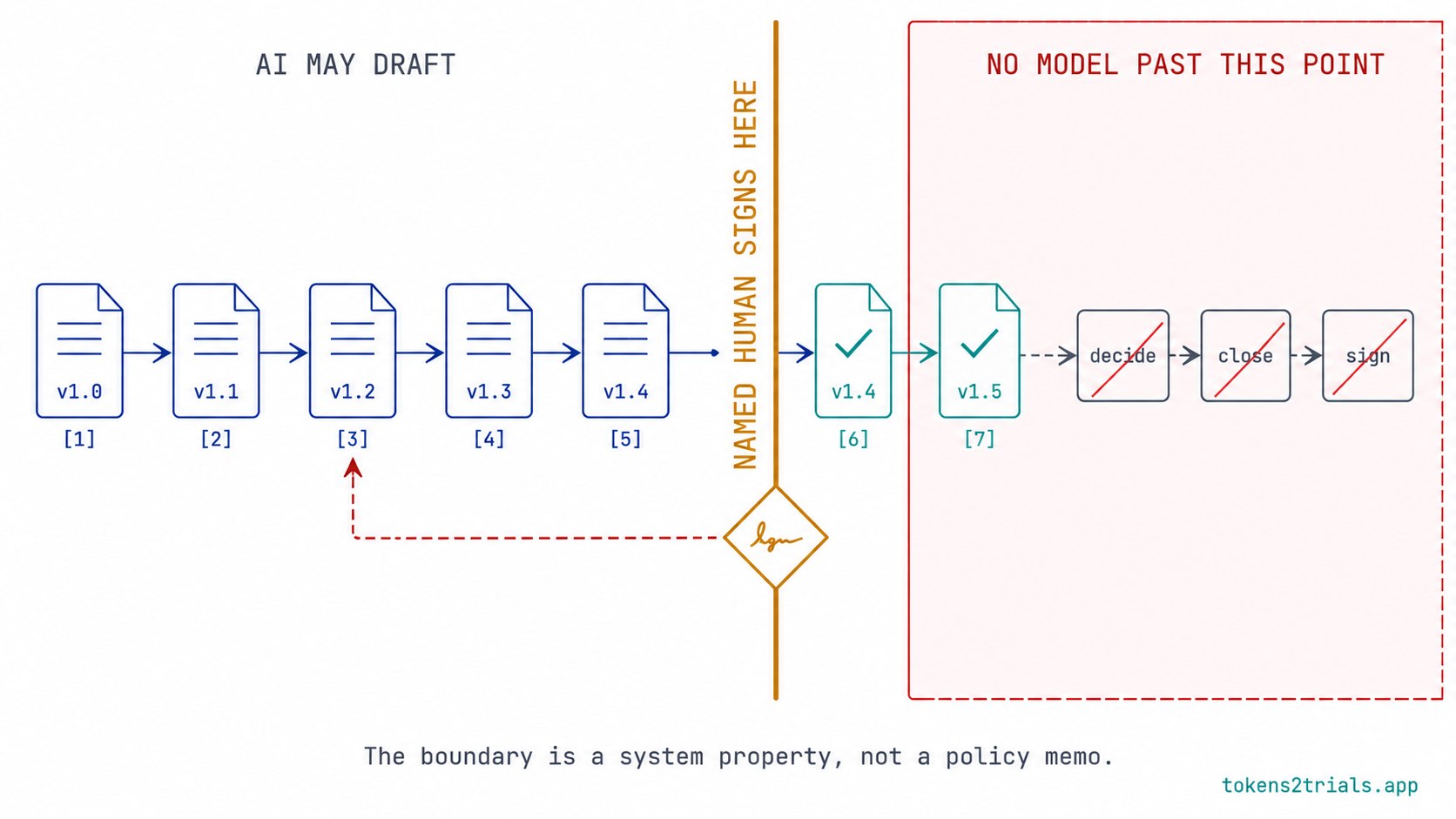
Confidence: hypothesis. The accountability culture below is drawn from published patterns and regulatory requirements in regulated clinical development, not firsthand deployment. The boundary-design method is an argument, not a shipped framework. Argue with it.
Every AI adoption deck follows the same slide pattern: a workflow diagram with green highlights showing where the model helps. The other slide — the one showing where the model is forbidden, who decided that, and what enforces it — is conspicuously rare. Teams map the “yes” with enthusiasm and leave the “no” to a policy PDF nobody reads.
Then an incident writes the slide for them.
Clinical drug development — an industry that has learned, expensively, over decades, exactly where automated systems must stop and a named human must sign — is the clearest existing proof that those boundaries are not timidity. They are engineered artifacts, as deliberate as any API contract. This piece walks through what they look like, and offers a method for designing your own before an incident designs them for you.
What a real “no” looks like
Clinical trials run on two documents this series has covered so far: the protocol (the trial's operating contract) and the clinical database (the evidence a regulator will inspect). Around each, the industry maintains hard boundaries. A sample, with their reasons:
This pattern is one piece of a longer treatment. The full essay is issue 2 of Stage × AI, a series walking the entire clinical-trial lifecycle stage by stage — what each stage really does, where AI helps, where it must not go, and one buildable pattern per stage:
full essayEvidence in, evidence out. Corrections welcome.