When Documents Become Data
The highest-leverage AI investment is usually not a better model. It's a schema.
Confidence: hypothesis. The document failures below are drawn from published industry patterns around protocol documents and structured-study standards, not firsthand deployment. The schema-first pattern is an argument, not a shipped system. Argue with it.
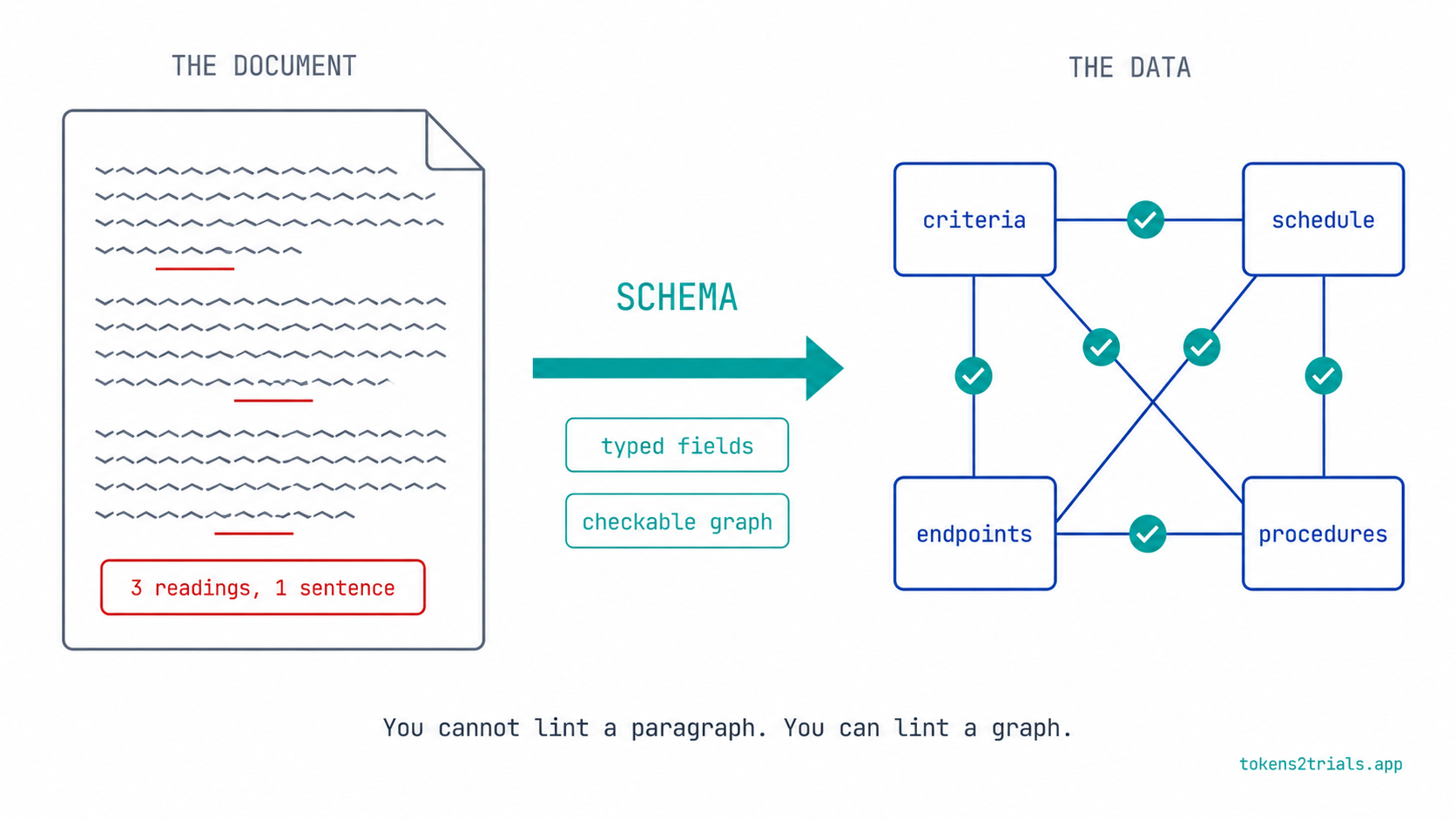
Every AI-for-documents project follows the same pattern. Someone points a retrieval pipeline at a folder of PDFs, the demo answers a few questions convincingly, and the team declares the document problem solved. Six months later they are maintaining a zoo of chunking heuristics, prompt patches, and regex extractors — because the real problem was never retrieval. The real problem is that the most important artifact in the workflow is a paragraph pretending to be a database.
Clinical drug development — an industry that runs on exactly this kind of artifact — shows what a prose-shaped database costs. And it points to why the highest-leverage AI investment in a document-heavy domain is usually not a better model. It is a schema.
A paragraph pretending to be a database
A clinical trial protocol looks like a document — a hundred-plus pages of prose describing a study. It behaves like a database. The data-capture system derives its electronic forms from the protocol's visit schedule. Statisticians derive analysis populations from its endpoint definitions. Safety teams configure adverse-event reporting (the tracking of harmful effects during a trial) against it. Half a dozen vendors configure their systems from its specifications. Every one of those teams performs the same operation: read prose, extract structure, build a system on the extraction.
This pattern is one piece of a longer treatment. The full essay is issue 2 of Stage × AI, a series walking the entire clinical-trial lifecycle stage by stage — what each stage really does, where AI helps, where it must not go, and one buildable pattern per stage:
full essayEvidence in, evidence out. Corrections welcome.