The Template Is Not the Truth
A shared consent template is right until one country's ethics committee requires a clause no other committee asks for. Then the local rule is the truth.
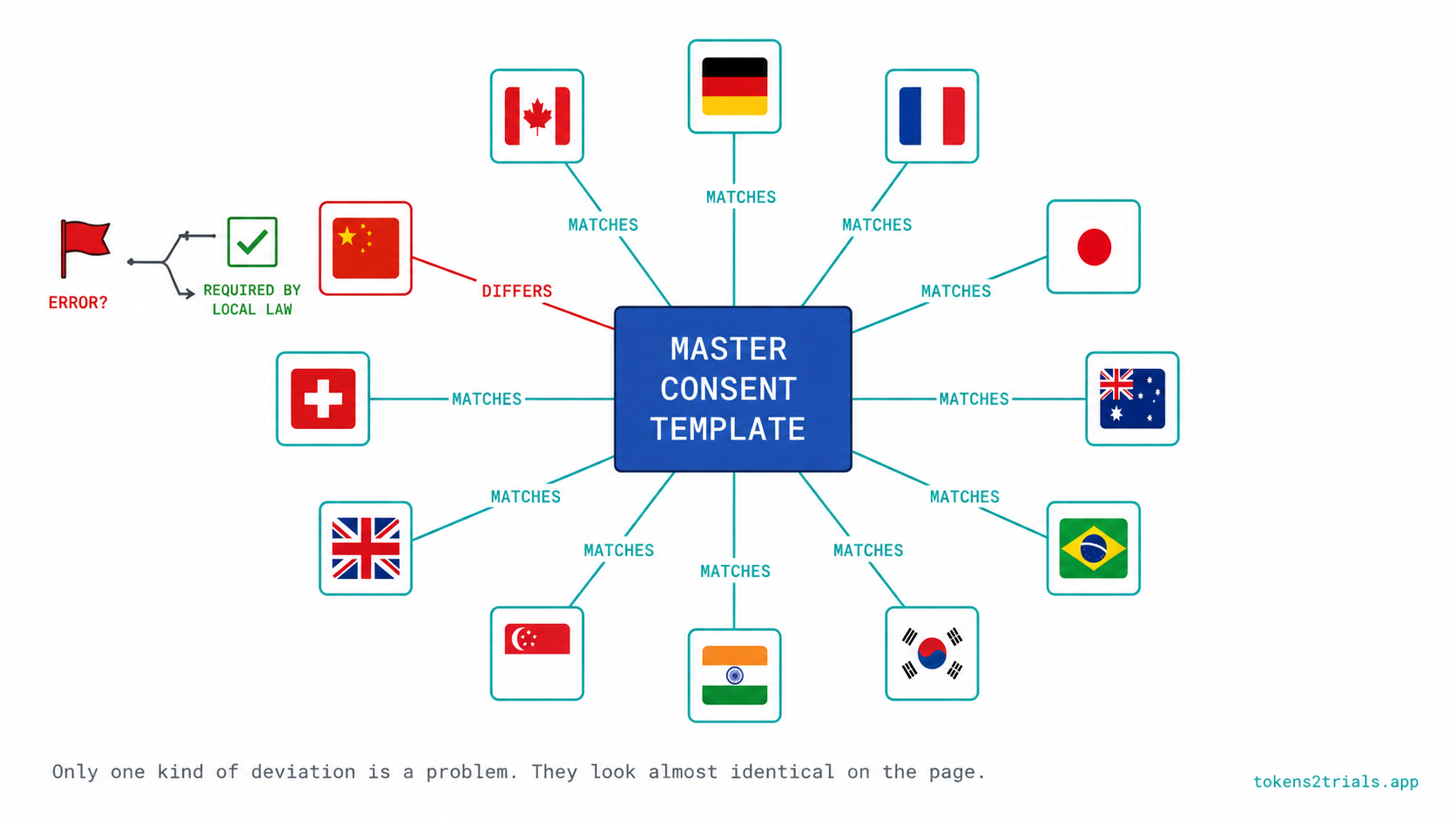
Confidence: hypothesis. The research below is real and cited. The organizational argument, distinguishing an error from a required local deviation, is this piece's own position. Argue with it.
Standardizing a document across every site in a trial is, most of the time, exactly the right instinct. A shared consent template, reviewed once and reused everywhere, is faster to write, easier to check, and less likely to contain a genuine mistake than eighty separately drafted versions. Right up until one country's ethics committee requires a specific consent clause that no other country's committee asks for, because it is not a style preference there. It is local law. At that point, the template is not the truth anymore. The local requirement is.
The clinical why
Multi-country trials run consent forms through translation into every language the trial touches, and every jurisdiction layers its own requirements on top of the shared core: a specific disclosure some ethics committees mandate, a data-protection clause a national law requires, a formatting rule about how risks must be presented. ICH's guidance on multi-regional trial design is explicit that trials spanning regions have to accommodate genuine regional differences in regulatory expectation, not flatten them into one version and hope reviewers everywhere accept it.
This pattern is one piece of a longer treatment. The full essay is issue 7 of Stage × AI, a series walking the entire clinical-trial lifecycle stage by stage — what each stage really does, where AI helps, where it must not go, and one buildable pattern per stage:
full essayEvidence in, evidence out. Corrections welcome.