Study Startup: The Slowest Document Wins
Stage × AI, issue 7 of ~38. One stage per issue: what the stage really does, where AI helps, where it must not, and one buildable pattern.
Confidence: hypothesis. The failure modes here are drawn from published research on trial startup timelines and site activation, not firsthand deployment. The buildable pattern at the end is not: it is an unbuilt design. Argue with it.
What this stage really does
Study startup is everything between “we have a protocol” and “a site may enroll”: regulatory submissions, ethics-committee review in every jurisdiction, site contracts and budgets negotiated one institution at a time, essential documents collected (licenses, CVs, training records, lab certifications), consent forms localized and approved, initiation visits done, systems access granted. The sites chosen in Issue 6 enter this pipeline; the patients forecast in Issue 3 wait at the end of it.
Under the Hood · 5
5 capability-angle deep-dives generalizing this essay's pattern for AI and software engineers.
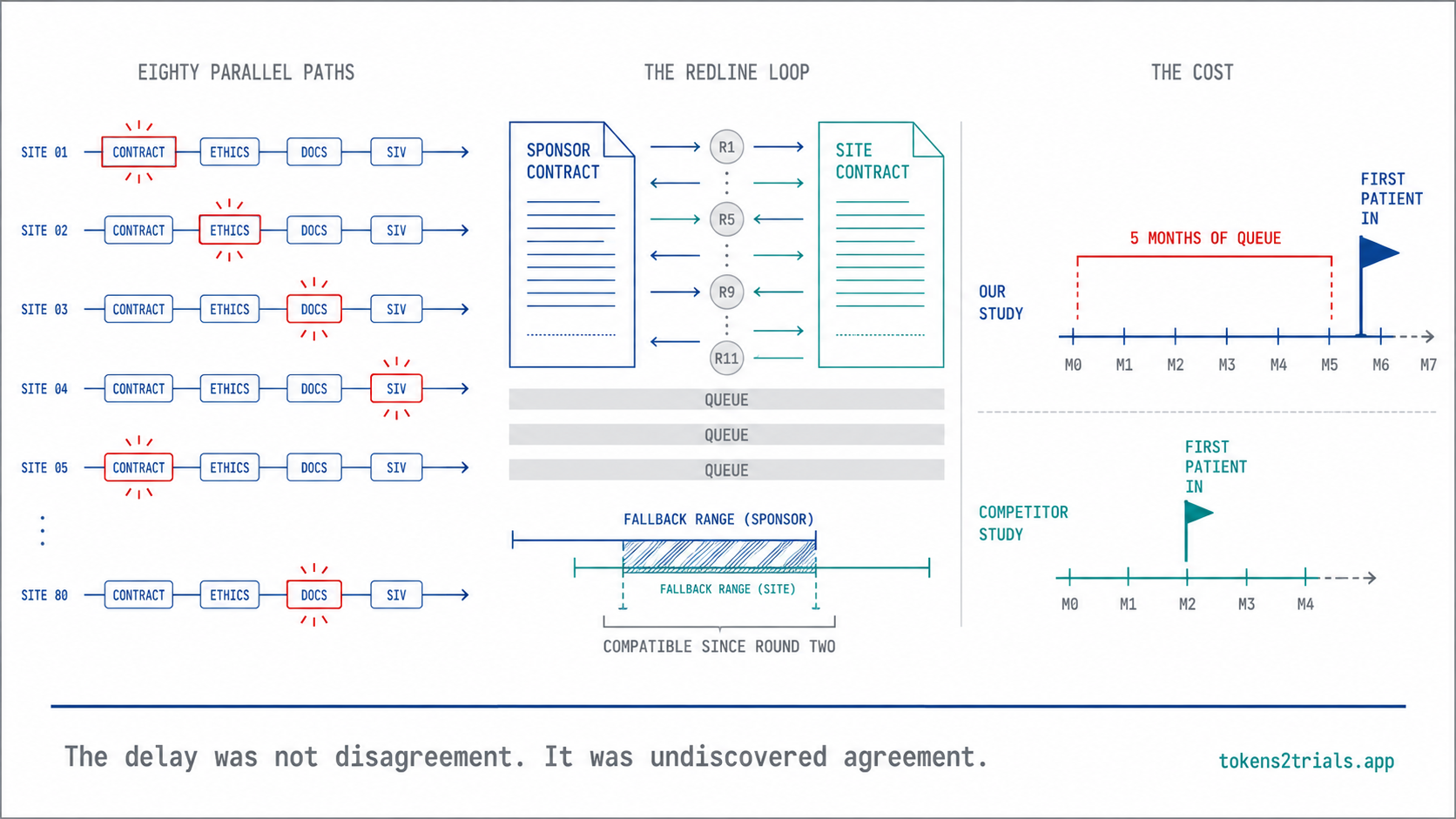
Eighty parallel sites, each its own race. The whole program enrolls at the pace of the last one to finish.
Five months of contract redlines can turn out to be five months spent not noticing both sides already agreed.
A budget review that takes three days at one site and 585 at another isn't a difference in skill. It's a difference in queue.
A model that flags a contract deviation in seconds is useful. A model that drafts and sends a counter-proposal on its own is a different kind of risk.
A shared consent template is right until one country's ethics committee requires a clause no other committee asks for. Then the local rule is the truth.