The Slowest Document Wins
Eighty parallel sites, each its own race. The whole program enrolls at the pace of the last one to finish.
Confidence: hypothesis. The timelines below are drawn from published research on trial start-up, not firsthand deployment. The pattern at the end is an argument, not a shipped system. Argue with it.
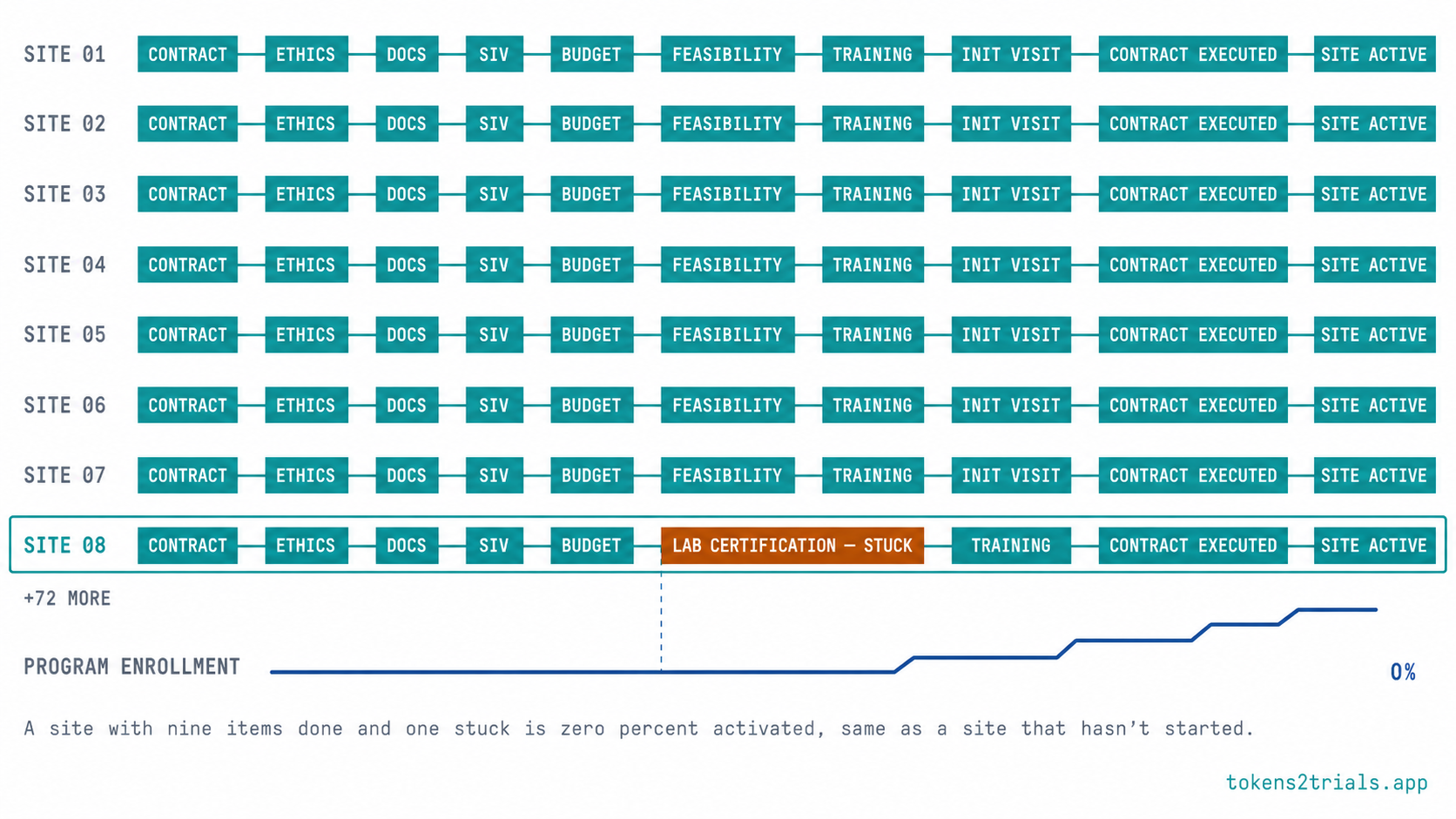
A trial has eighty sites. Seventy-nine of them finish every piece of paperwork inside three months. The eightieth is stuck on one lab certification that keeps bouncing between two departments. The program does not enroll at the pace of its seventy-nine ready sites. It enrolls at the pace of its slowest one, times eighty, because every site is its own separate race and the finish line for the whole program is wherever the last runner crosses it.
That is the part people miss about study startup. It looks like paperwork. It behaves like a queueing problem.
The clinical why
Between a finished protocol and a site's first enrolled patient sits a long list of separate approvals: regulatory clearance, ethics review, a signed contract, a signed budget, and a stack of essential documents proving each investigator and each piece of lab equipment is qualified to run the trial. A site cannot enroll until every item on that list clears. Not most of them. All of them.
This pattern is one piece of a longer treatment. The full essay is issue 7 of Stage × AI, a series walking the entire clinical-trial lifecycle stage by stage — what each stage really does, where AI helps, where it must not go, and one buildable pattern per stage:
full essayEvidence in, evidence out. Corrections welcome.