Feasibility: The Forecast Everyone Wants to Believe
Stage × AI, issue 3 of ~38. One stage per issue: what the stage really does, where AI helps, where it must not, and one buildable pattern.
Confidence: hypothesis. The failure modes here are drawn from published industry patterns and clinical-trial recruitment literature, not firsthand deployment. The buildable pattern at the end is not: it is an unbuilt design. Argue with it.
What this stage really does
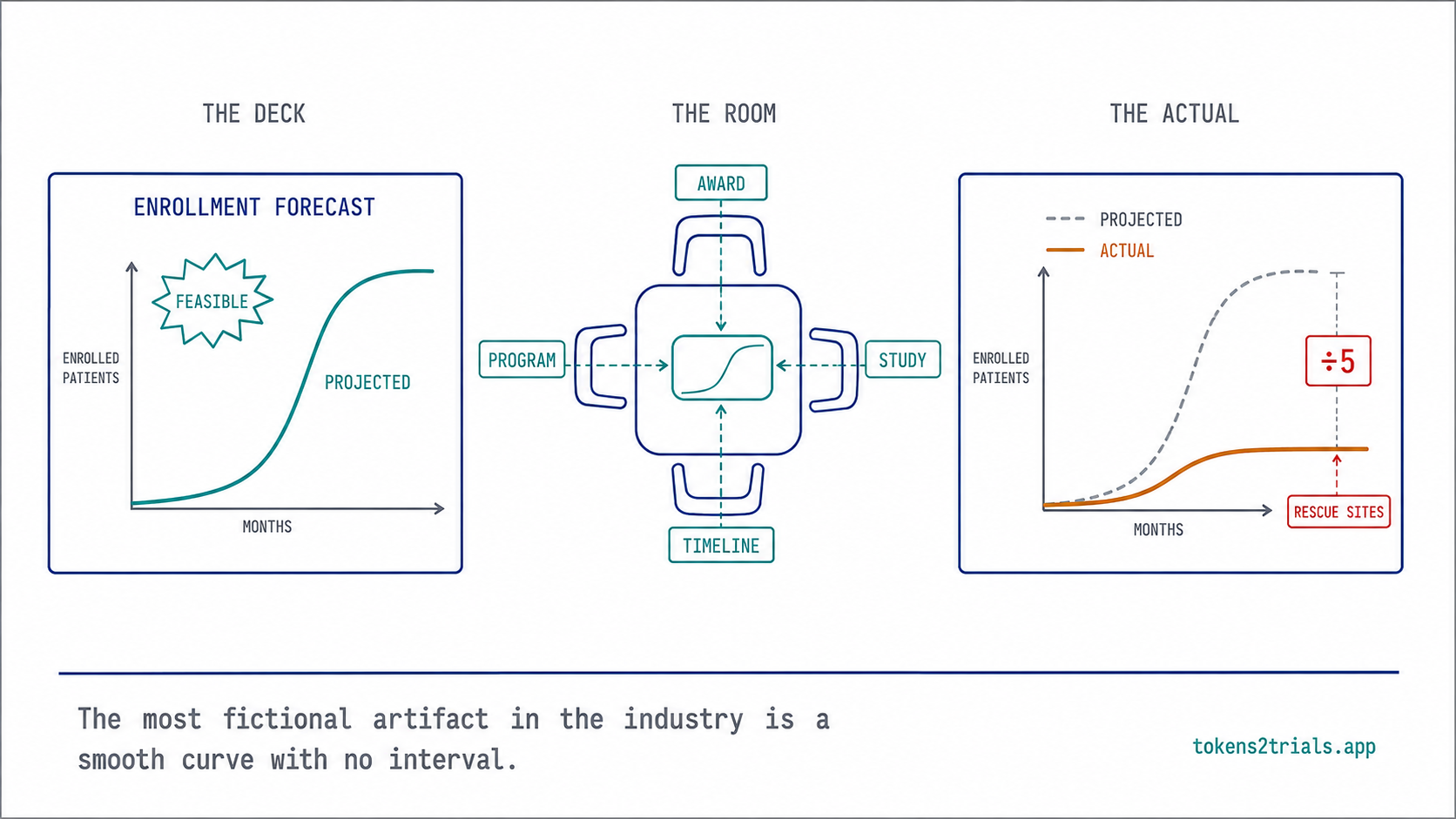
Before a sponsor commits nine figures, someone must answer an unglamorous question: can this trial actually be run? Feasibility assembles that answer: which countries, how many sites, whether the patients exist, how long ethics and contracting take per region, which competing trials are fishing the same population, what the standard of care does to the comparator arm, and the number the whole deck exists to produce: the enrollment projection.
Under the Hood · 5
5 capability-angle deep-dives generalizing this essay's pattern for AI and software engineers.
A fluent, citation-studded yes has no tether to the truth unless something outside the model enforces one.
Precision that presents a distribution as a single measured fact isn't rigor. It's the uncertainty, deleted.
A private calibration adjustment fixes the next forecast. A published one fixes the next submission.
Averaging three forecasts into one number destroys the one thing worth knowing: which source to trust.
A forecast without an interval, a date, and a name isn't a bet. It's a slide nobody can be held to.