Study Design: The Answer Is Chosen Before the Question Is Asked
Stage × AI, issue 1 of ~36. One stage per issue: what the stage really does, where AI helps, where it must not, and one buildable pattern.
Confidence: hypothesis. The failure modes here are drawn from ICH E9(R1)'s own rationale for the estimand framework and widely reported industry patterns, not firsthand deployment. The buildable pattern at the end is not: it is an unbuilt design. Argue with it.
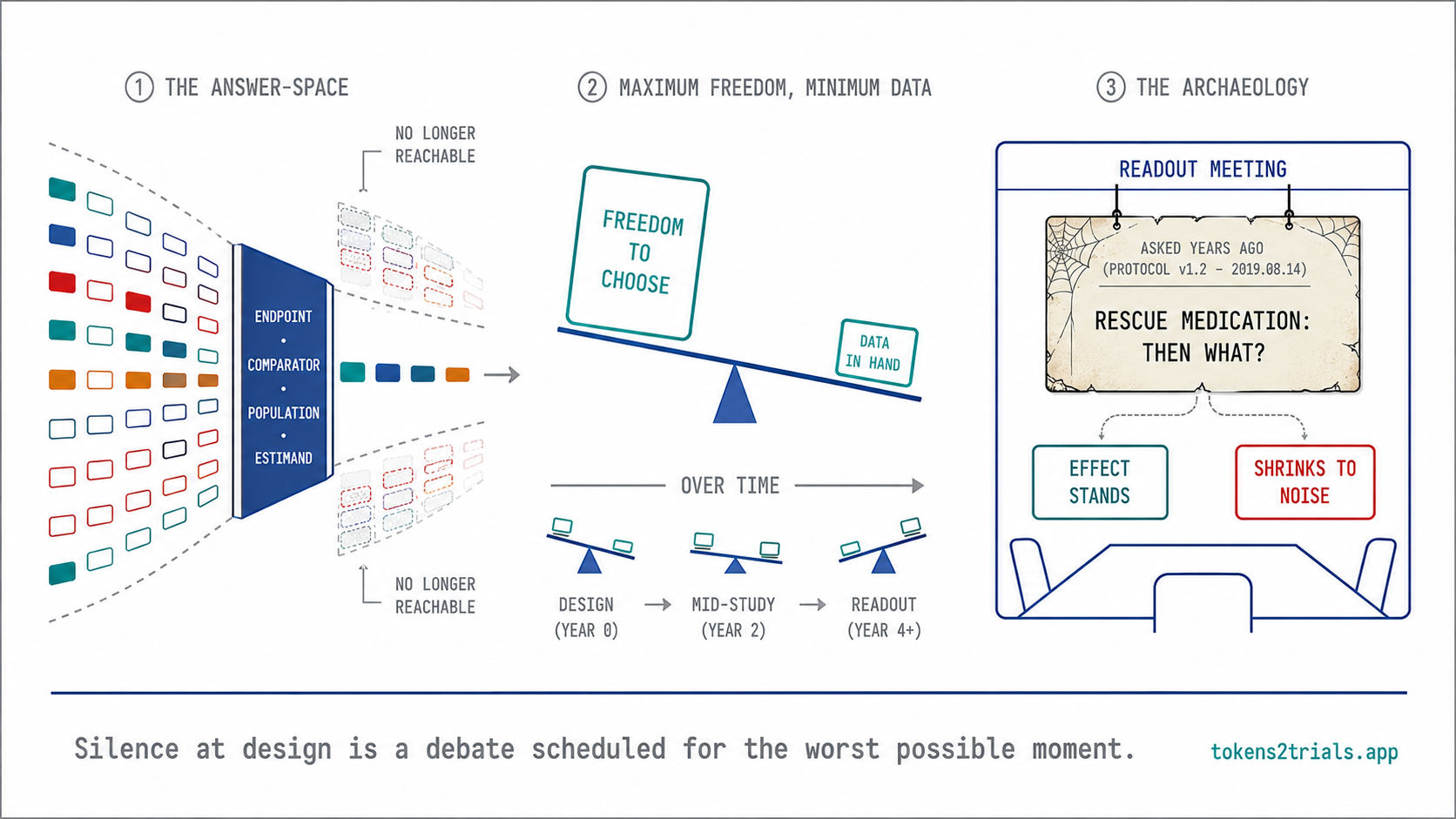
What this stage really does
Before Issue 2 writes a protocol, someone decides what trial to run: the endpoint and how it is measured, the comparator, the population, the duration, the randomization scheme Issue 9 will execute, the estimand — the precise question, down to what happens when patients take rescue medication, discontinue treatment, or experience other intercurrent events. ICH E9(R1) gave that last decision a name and a framework precisely because, in the addendum's own words, “avoiding or over-simplifying the process of discussing and constructing an estimand risks misalignment between trial objectives, trial design, data collection and method of analysis,” and because “it is necessary to address intercurrent events when describing the clinical question of interest” — exactly the readout-stage debate this essay opens with.